Showing posts with label singularity. Show all posts

Sunday, February 24, 2013

Find Your Inner Vulcan


There is a famous Vulcan puzzle that has a purpose described by Voyager Lieutenant Tuvok as restoring the "structure of harmony". This game is used for the aim of going beyond Zen style Buddhist disembodiment, and instead allows Vulcans to focus on being rational and devoid of harmful emotions. The blocks have a variety of 3 dimensional geometries, that when stacked can easily tumble like a house of cards. Vulcans have the ability to go without sleep for up to 5 earth days, which it sometimes takes for them to complete the task. Other times it is done in a matter of minutes. The interesting thing about this puzzle is that there is no predefined form. It is assembled differently each time. So, despite the rather machine-like construction of these blocks, the outcome is creative. It is a humanoid’s attempt to be a machine, and his embrace of the outcome, that it is not merely a repetitive form, but something unique to that moment.
 As I look at these fictional characters trying to cope with the always present annoyance of emotion, I wonder if this quality the Vulcan is finding in this exercise is not merely mechanistic. What is it about creating unique forms based on that particular moment that makes a Vulcan easier for us as Trekkies to relate to? For some reason the one important human characteristic that I always think of as crucial in our ability to both improve ourselves and thrive as a species is empathy. The Wikipedia definition of empathy states: “Empathy is the capacity to recognize emotions that are being experienced by another sentient or fictional being”. At first glance this definition does not seem to apply  to a solitary act, but I would argue that in a very important way it does. The entire purpose of combining rationality with creativity is an applied discipline. When a meditation that results in variations depending on personal interactions of the day is completed, it is assumed that those interactions play an important role. Therefore to complete the task effectively the Vulcan must possess empathy. While this may be a stretch, it is allowed to be, as we are talking about characters in a TV space drama. The analogies that this suggests however, I think are transferable to us actual humans, not just pointy eared aliens.

This apparent contradiction between the logical mechanistic mode, and the creative empathetic one, is not only one to consider when assembly a starship crew, but also in a technology company, or even an artificial intelligence. I was attending a salon that the social scientist, and bestselling author Jonathan Haidt was a guest speaker for. The group was a libertarian organization called ReasonFoundation, whose name Haidt seemed to suggest, (based on his in-depth research), explains libertarians fairly well. It seems that empathy and rational decision making ability are inversely proportional. Libertarians seem to be the Vulcans of the political ideals spectrum (my words not his). This is in a way similar to very high functioning individuals with autism, such as many people with Asperger’s syndrome, who populate some of the best computer science departments and silicon value development labs. Haidt implies a mutually exclusive tendency between libertarian logical rigor, and a lack of empathy. While he certainly has a lot of research, there may very well be something more fundamental about the nature of humanity that he is missing.

Though I hate to jump around between fictional characters, real people, and robots I am going to do it anyway. Many people, who I promise you, are not all nuts, are considering the programming parameters for creating human-like artificial intelligence. I and many others think that computer technology is accelerating at such a rate that we will be faced with both practical and ethical questions about what and who these future highly intelligence machines should be. The former Singularity Institute, now known as MIRI, has been working on this very issue with full time researchers, and yearly conferences.

 Perhaps there is a something to the dichotomy of empathy and reason that we should consider when allowing our machines to become sentient. You notice I use allow, as I have decided to take a rather libertarian approach to artificial intelligence. As an analogy, humans have programming which is encoded in our DNA. A good generalized AI algorithm also has the equivalent, perhaps not written in ATCG base pairs on a biopolymer, but rather in binary logic, written in C++  and eventually printed onto silicon. We know how to create learning algorithms already. The IBM computer Watson, and most Google products, as well as thousands of others do it. These are machines that start as newborns with pre-programmed tools for learning  and as they age get smarter.  In some ways current AI does better than humans, and in some ways humans do better than computers. 

This is old stuff (well Watson was 2 years ago. I guess that is old in modern tech terms), and easy to understand. What we don’t know about human genomics, and equally don’t know how to do in computer science, is to find, or program that fundamental structure so that pure logical thinking, and empathy can co-exist. The reason that they should co-exist in AI may seem obvious. We would want machines that inherently have superior abilities, such as perfect memories, but also have the heart of an empath, or at the very least the heart of a libertarian Vulcan.

Monday, September 17, 2012

Ambien Consciousness


This is a blog which was published last year for the Singularity Summit. Since the Summit is over, I decided to post it here for anyone interested who did not read it before.

This is a guest post from Matthew Putman. If you would like to submit a guest post proposal for possible inclusion, please emailadmin@singinst.org.
~~~
The first of the big Ambien stories occurred in 2006 when Congressman Kennedy crashed his car while driving throughout Washington DC in the middle of the night. At first glance, the excuse upon his arrest, that he was driving recklessly due to the fact that he was not awake while driving, seemed absurd. As experts started appearing as well as other people who had strange experiences on Ambien, they realized that this was a possibility. It was possible to be completely asleep at the wheel. It was also around this time that I heard about a young man who had been in a vegetative state for years, who was woken up by Ambien. As long as he took his Ambien, he would be awake. What was the amazing power of this common sleeping pill?When I heard these stories it made me do two things; take Ambien to see what it was like, and to think more deeply about consciousness. What the reports were dealing with was not as simple as being awake or asleep, instead it spoke to a much larger issue, which is the biggest question asked in Philosophy; what triggers consciousness. While consciousness means different things to different philosophers, the layman like myself, thinks of it as the small part of our brains that are making us think we are in control. It is the bit that is associated with choice. That part our brain is not the most active, even if we don't know where it is. We can doze off, and our metabolism keeps working. The only thing we don't do is choose. The Ambien research puts that in the forefront of my consciousness. I realized that if I could do things as complicated as drive a car without this traditional type of conscious wakefulness, then perhaps consciousness wasn’t as complex of an evolutionary trait as we thought. Or as an evolutionary trait, it may be easier to pinpoint the reasons than we previously thought.
This has to do with one aspect of Singularity, which is finding the consciousness trigger for the possibility of a neural upload. Personally, as a technologist, I have always found this option more appealing than other life extension ideas, such as stopping cell aging. The reason is purely statistical. That is, the body will someday be destroyed no matter what. Hurricanes even come to New York these days, and disasters of all kinds will persist despite the reversal of cell aging. The difference is that the death of a 200 year old will be perceived as the death of child is perceived now. It will be a larger tragedy as the potential for a still longer life is larger. Still in cosmic terms the extended lifespan will still be insignificant. Upload is much different. In upload the person is embedded in silicon or another crystal. These crystals were formed billions of years ago. If our minds remained embedded in crystals for the next billion years that is significant. The big question though always becomes whether it is us who are embedded, or just a biography of us.
This is where the Ambien, consciousness thoughts come into play. If by us we mean the conscious us, then I would say the recreation of consciousness should be the easiest part of the extremely complicated upload problem. The ease by which Ambien can toggle consciousness and unconsciousness, and sometimes even blur the two can provide clues to engineers about what part of the human machine is responsible for why we consider ourselves to be human. The neuro receptors that Ambien acts upon have counterparts to other properties of existence not related to consiousness. This is where the engineer needs to take an existentially humbling move. That move is to follow the lead of neuroscience, and naturalism where research shows that it is highly probable that choice is an illusion. If there is no choice, and counter causal free-will does not exist, then the consciousness problem for uploaded human systems can be solved. It is simply a matter of programming  commands, which are  similar to what evolution has programmed into our genomes that say you are now choosing. That means having the ability to move, but have a regression that is active enough to always be able to place that movement in only one direction, at one time. In other, words program the illusion of freewill, and you will have programmed consciousness into an otherwise perfectly well uploaded unconscious human brain.
None of this is yet possible of course, but we can experiment a bit with AI on consciousness, by comparing an Ambien type action without awareness to a completely alert awareness, and place it in terms of choice. The human problem is the enormity of the data. The variables to create a regression analysis to know the next move are just too many to handle for the moment. It would also take the fun out of it all to be able to look at any future point on the regression to see what “choices” you have made. What is more possible is starting with blank slate situations, and evolving them to the point of consciousness. Consider an AI program to drive a car, like Rep. Kennedy. What would be the the algorithmic approach to distinguishing the difference between the Ambien induced driving and the awake driving? It would only be that the awake driver understands at least a series of potential outcomes, where the Ambien driver does not. Both may result in the same thing. The real, or artificial Rep. Kennedy may drive from home to Capital Hill, but only the awake one will know that he is doing it.
Does this shed any light on the possibilities of uploading the human brain or understanding one of the largest questions in philosophy? Most likely not much, but it does get me thinking of the toggle between consciousness and unconsciousness, and how little the difference between the two is. This is a problem as big and as interesting as any for engineers interested in Singularity solutions to pursue.
Putman is an Applied  physicist who is both a researcher and lecturer at Columbia University and the CEO of Nanotronics Imaging,.  He is also a musician, poet and blogger. For more on Matthew go to www.matthewcputman.com.

Monday, March 28, 2011

Even The Gods Die

The horror of the tsunami in Japan is not in any way lessened by the hundreds of other natural disasters we have had in recent years. In fact the fear of a Nuclear melt down in the process makes it even more urgently terrifying than most. This is not at all a surprising thing to say, yet something struck me about this month’s events, as I have been reading a lot, and spending time with people involved in what is a multifaceted movement around a technological Singularity. Many of you know about this through Ray Kurzweil who is most famous for explaining it years before Time magazine gave it a cover declaring that 2045 was indeed the year when humans and machines will be unrecognizable from each other. Perhaps that is one of the more extreme predictions, but one which seems more down to earth  is actually more philosophically complex than even how we interact with machines. That is an extrapolation that a reduction of aging will move at a faster rate than aging. I have not studied this enough, so I apologize to the really deep thinkers and scientists (such as Eliezer Yudkowsky) who have plotted historical technological growth so precisely as to make this prediction in a rather convincing way. During this same time there was the release of a documentary about Kurzweil called “Transcended Man” , which I immediately watched. Though this is a terrible spoiler, the film’s most profound metaphysical revelation came in the last question of the film, when Kurzweil was asked “is there a  God?” His reply; “not yet.” This is a profound insight into his position that humans and technology will be equivalent to what we now consider god-like characteristics. This is not a new thought, that humans can catch up with “God” or “The Gods” of mythology. After all, much of the powers of the Greek Gods of mythology are now in our power. Those abilities which we recognize as god-like may certainly be within the grasp of human created technology and artificial intelligence. So the goal for Singularity followers and Kurzweil is to stay alive until 2045, or around then, when the exponential growth they predicted reaches the intersection with the the Singularity. I have written about how appealing yet complicated this is myself 3 times (for instance here), so any reader of my blogs is likely tired of hearing that I am attracted by the desire to live forever, but at the same time philoshophically bound to mortality. This was especially evident in an obvious way that I had not considered exactly before. The earthquakes and tsunami in Japan remain an easy reminder that stopping aging only succeeds in prolonging life, which is an important goal. After all that is what hospitals and medicine exist for. That is what the NIH is for. That in some ways is also what the Singularity is for. What it also seems to be suggesting is something metaphysically unavoidable, which is the deeper existential reality that no matter how long we may live, we will in fact one day die. A Tsunami, a car crash or a bomb being dropped on our homes. The goal of the technology has  to be practical not metaphysical. Death is reality, singularity or not.

Wednesday, December 8, 2010

Facing Eternity In San Francisco

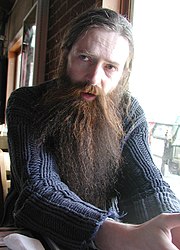
Last night I was walking to a technology event in San Francisco, and being early and thirsty from a reckless run up and down Lombard Street, I found a pub to grab a beer. Though it was dark, I noticed an absolutely impossible not to notice character in the science world, Aubrey De Grey. De Grey has a beard which goes below the waste, making the fact that I wear Mickey Mouse socks and play the banjo look much less eccentric. I have written here before about De Grey, (The Jellyfish)and the philosophical struggle I have, which wavers between a desire to embrace his research to engineer immortality, or to brush it aside as harmful delusion. I introduced myself, and unsurprising he is a major intellect, who enjoys a pint and has an excellent sense of humor. When I told him how much I liked living in Paris, he said something which is insightful, but not usually pointed out which was “why did you like it? Certainly it wasn’t for the beer.” So within 20 minutes I was again thinking that it might be possible to live forever, even though we didn’t even talk about this.

The evening was intriguing, mind boggling, encouraging and the food was delicious. This was a group of 200 hundred or so Silicon Valley insiders who were there to talk about a range of foundations that are especially forward thinking, one of which was The SENS Foundation, which De Grey is a founder of. The noble pursuits of the group were on the border of science, economics and possibly science fiction, which is a place I am comfortable inhabiting. With all of the interesting people I talked to, I thought of every conversation through the lens of immortality, as represented by De Grey. Suddenly my reliance on quantitative data became a little less stringent than it usually is amongst scientists. All of the science presented was well researched and intelligent, but many of it exists just beyond the complete technological, or even mathematical grasp of our time. This is important I think. I write about feeling on the fringe of science and music, and the respect I have for the fringe. What I realized from this event is that some of the most successful and smart thinkers and entrepreneurs in the country are not so much on the fringe, but off of the table completely. In this frame of mind a singularity, nanobots and even living forever are technical challenges, not fantasies. For many of these people the science and technology fills the place in their lives that the combination of science and art fill in mine. So is a garage start-up mentality dedicated to eternal rejuvenation (or super humans, or nano robots) a way of dealing with existential dread, or more simply an act of the curious inventor? Are either of these more noble than the other? If an unexamined life is not worth living, does it mean that the search for immortality is examining life more or less? The film maker Darren Aronofsky made a film I liked very much called “The Fountain”.  When asked in an interview why he made this film about the search for the fountain of youth, set in the past, present, and a future in a floating bubble in space, he said that it was to show that at some point, regardless of how long we can live, humans need to come to terms with death. It is perhaps the greatest emotional and intellectual chasm I have; that I believe De Grey and Aronofsky at the same time.