
 When did brainwashing both employees and customers into submission become the hallmark of the successful American corporation? Is the Walmart, Apple, Disney, Whole Foods etc chant a replacement for religious disillusionment, or yet another religion for those seeking comfort in an increasingly uncertain society? I have never given this much thought, at least in the extreme in which credos, and group hugs are not uncommon in a workplace where benefits and pay are so poor that otherwise intelligent workers would be on the picket line rather than on fan blogs.
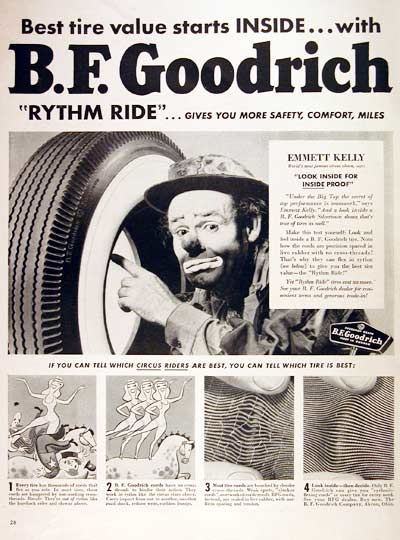
Of course corporate culture, and even individual identification with the company has been a staple of the American success story. Growing up in Akron Ohio there was family identification not by what religion you were, but by which tire company your family was associated with. My grandfather being a BF Goodrich executive was so ingrained as important to me, that I still feel a loyalty to a brand, which is no longer even a company. BF Goodrich was bought by a group of other companies, most notably Goodrich Aerospace and Michelin Tire. In fact in 2002 our family business bought one the remaining BF Goodrich companies, which was the tiny instrument division. I could therefore see the BF Goodrich brand on products I was selling, and for some irrational reason this made me feel good, and even important. Akronites from Firestone, Goodyear and General Tire all felt this same way about their respective organizations. There were baseball leagues, and BBQ’s, as I am sure there were in Detroit for the auto companies. There was also brand loyalty, as there is today amongst Apple and Disney employees. Every BF Goodrich employee used BF Goodrich tires, not just because they worked there, but because they believed them to be the best. Driving into the BF Goodrich lot with Firestone Tires would be much like going to your job at Apple with an Android phone. So I wonder if identification with the company you work for is just a fun part of the American story. In fact as an owner of companies now and in the past, I hope for such a thing. I want a culture of pride for the products, and the ideals of the company, yet the more I look at today’s corporate culture philosophies, at least for a few very successful companies, I see some big differences both from the companies of the past, and of the type of company culture I would like to be a part of.
First of all is a basic change in perception about what a company is meant to provide for the employees. While we hear that people feel more entitled to benefits now than they did in the past, a look at the situation doesn’t seem to provide evidence to this, with only rare exceptions. For the most part the companies of my rust belt youth provided full pensions, and living wages. Though this is certainly a small sample set, a BF Goodrich factory worker in Akron in 1960 on average made $3.00 - $4.00/ hour. Adjusted for inflation $4.00/hour is $29.82 today. By contrast a Walmart Clerk makes $8.00 in 2011, and an Apple “Genius” $14.00. Disney “Cast” members, are paid even lower wages than Apple Store workers. An Ohio Disney Store pays $10.00/hour. None of these wages constitute a living wage (most employees work more than one job), yet workers in these companies are dedicated with a passion that borders on fanaticism. Though I don’t personally have the Apple credo, I have been told by someone working as a “Genius” (though clearly not paid as one) that there is a section that reads that you will give “your heart and soul to the company.” Though my Grandfather liked BF Goodrich I am sure that his soul was never in any danger of being trapped in a tire press.
These things of course cannot be compared this easily, and a judgement not made based only the numbers. Perhaps the value of a factory worker towards corporate profit is greater than a service job, though the profits of all the above mentioned contemporary companies do show a level of profit, and executive pay unheard of in 1960. It may be that factory workers are paid more because the job is so much more physically demanding. This would make sense, but most studies of job pay show that educated jobs requiring technical skill are higher paid than ones that are physically challenging.
Not to make this blog boring by taking the opposite side of my own debate, but it is true that by many measures the standard of living is much better now than in 1960, despite the greater inequalities. The underpaid Apple Genius still has an iPhone, which was a technology unthinkable even 10 years ago. Our lives are richer for the technologies being created by the businesses who also create these cultish cultures. Even Walmart makes it possible for low income families to have a full wardrobe of clothes.
So looking at all of this I find myself morally appalled by what I consider corporate brainwashing for low wages. Apple has made blind followers and soldiers of its employees, and blind faith in anything is something I despise. On the other hand I am glad that companies are successful, and adding to the general knowledge and lifestyle of the population. This becomes an ends justifying the means situation, and I have to say that I don’t think they do. I think you can be a good company, making a powerful, wonderful, life-enriching products, without developing a cult in order to hide the fact that you are just a company, and to a certain extent take advantage of your employees. I also find it sad that Apple has the largest market cap in the world, not because they don’t make a great product, but because that greatness is based so much on an illusion. It is the illusion that by having the product you are smarter, and by being called a genius at work it justifies a low wage.
As a bit of a disclaimer I may be called a hypocrite for some of these statements. The start-up company I am the CEO of is called Nanotronics Imaging, and we employ technologists. They are all terrific, and I would do whatever I could to get them to stay with us, even if it meant a morning pep talk and chant. We even do some strange things like calling each other Nanotrons, and use from time to time some geeky Star Trek terminology and titles. So this is a warning to myself that the goal of a company requires a responsibility to be honest, and to be a place where working is enjoyable and rewarding. It does not require religious like devotion, though like Kirk I wouldn’t mind if our team called me captain from time to time;)


