Showing posts with label Apple. Show all posts

Thursday, August 9, 2012

An Apple a Day Should Keep the Student Away


Several years ago we were looking for a school for our daughter in New York. For any of you that don’t live in New York I don’t mean to belittle your choices, but to be honest I can’t imagine any place in the country quite as confusing where schooling is concerned as New York. There are a range of religious schools, but for many reasons these are out of the question for me. More reasonable, yet mind-blowingly expensive, are the myriad of private schools, and even free public schools, which are not in any way created equally.  For instance my 7-year-old goes to a public school where half of the day is taught in French. There were many memorable visits, but the school I was most impressed with was an Upper West Side private school that was very nice. It had high student to teacher ratios (which I no longer care about by the way), nice carpeting, smart boards, musical instruments for everyone, and something that I was impressed with at the time; a laptop for every child. What better way to be in touch with 21rst century education than with having a laptop in the hands of every child? Then my wife made a wonderful point that I couldn’t believe a lifetime PC user like me didn’t notice. She said “they are all Macbooks. The school is training kids to be users and consumers, not creators”. She was completely right. There is nothing wrong with an Apple product, but they are designed to put the user interface of an application ahead of creativity itself. This is even truer of IPADS which are all about buying then using, rather than content creation.  If this concerns you it is another reason to read the book Program or Be Programmed by Douglas Rushkoff which I recommend several times in these blogs.

I don’t know the answer for what should be provided, but the Negroponte one laptop per child is a much better solution, as using a scripting language is a key feature. For students with these laptops, logic is more important than application. What did occur to me is that computers have become somewhat mysterious so that many of the basic functions of them are not understood by many of us. I touched on this in my blog here, but there is a larger societal issue beyond just technological literacy at play. It is about the ability to comprehend then use our technology to understand the global network that we are all a part of.  An easy example of this to imagine is a high schooler who has a Gmail account. How much thought does that teenager give to what is stored on his device versus what is stored in the cloud? And even if he does realize that the Cloud is where most of the important information of his life exists, is there any understanding of how bits are distributed and reconfigured at various server farms? If there is, which I highly doubt, then is there an understanding of the economics behind those corporations and the financial goal of having control over all of that information? This is all without even discussing coding and creation of content, but let’s make the crazy assumption that the teenager does know the financial model of Google, the distribution channels of e-mails, and the location of the servers where that information is stored. If that well informed kid wants to change the system in any way, even just for himself he then needs to know a little bit about programming.  Let’s say the kid doesn’t mind that system, and accepts it for most things. Then let’s say he wants to create videos that are cloud-based and created through an open source community. What if he doesn’t have the money to buy the Apple product called Final Cut Pro, or just doesn’t want to, and I-Movie that comes with the laptop just doesn’t do enough.  He could use open source free software. If he really has ideas, in addition to using he can both create his videos and then actually learn enough programming to contribute to the open source project that he has been lucky enough to utilize. He has now taken the first step to becoming a programmer. Even if he decides that the open source movement is not the most efficient way to create software or value, he can do it on his own, and create products himself. He will be one of his generation to make things better, rather than just accept what is already there.

Would any of this story be true in the fancy private school with the free Macbooks? It all could be, but I don’t think it would be. The bundled Mac, with I-Movie, I-tunes and Garage Band make it all too tempting for all of us to benefit from the great design of the present. There is nothing wrong with this, except that education is meant to inspire critical thinkers who will design the future. Even if this fictional kid did go outside of the Apple universe and do those things with his Macbook, he wouldn’t be able to go much further, with no room for microcontrollers, expansion etc. Apple has always had a reputation for locking in the user. Let’s make sure we don’t lock in our kids. 

Thursday, August 18, 2011

Captain Putman On Deck


When did brainwashing both employees and customers into submission become the hallmark of the successful American corporation? Is the Walmart, Apple, Disney, Whole Foods etc chant a replacement for religious disillusionment, or yet another religion for those seeking comfort in an increasingly uncertain society? I have never given this much thought, at least in the extreme in which credos, and group hugs are not uncommon in a workplace where benefits and pay are so poor that otherwise intelligent workers would be on the picket line rather than on fan blogs.

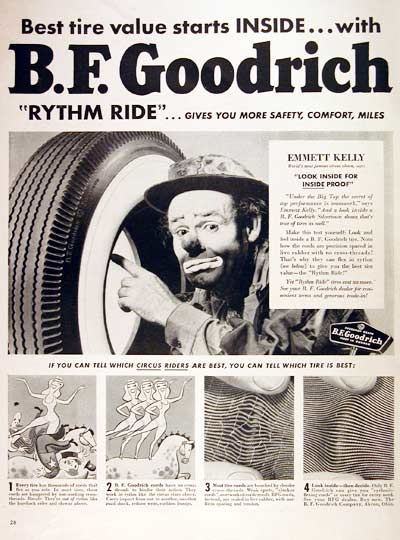
Of course corporate culture, and even individual identification with the company has been a staple of the American success story. Growing up in Akron Ohio there was family identification not by what religion you were, but by which tire company your family was associated with. My grandfather being a BF Goodrich executive was so ingrained as important to me, that I still feel a loyalty to a brand, which is no longer even a company. BF Goodrich was bought by a group of other companies, most notably Goodrich Aerospace and Michelin Tire. In fact in 2002 our family business bought one the remaining BF Goodrich companies, which was the tiny instrument division. I could therefore see the BF Goodrich brand on products I was selling, and for some irrational reason this made me feel good, and even important. Akronites from Firestone, Goodyear and General Tire all felt this same way about their respective organizations. There were baseball leagues, and BBQ’s, as I am sure there were in Detroit for the auto companies. There was also brand loyalty, as there is today amongst Apple and Disney employees. Every BF Goodrich employee used BF Goodrich tires, not just because they worked there, but because they believed them to be the best. Driving into the BF Goodrich lot with Firestone Tires would be much like going to your job at Apple with an Android phone. So I wonder if identification with the company you work for is just a fun part of the American story. In fact as an owner of companies now and in the past, I hope for such a thing. I want a culture of pride for the products, and the ideals of the company, yet the more I look at today’s corporate culture philosophies, at least for a few very successful companies, I see some big differences both from the companies of the past, and of the type of company culture I would like to be a part of.

First of all is a basic change in perception about what a company is meant to provide for the employees. While we hear that people feel more entitled to benefits now than they did in the past, a look at the situation doesn’t seem to provide evidence to this, with only rare exceptions. For the most part the companies of my rust belt youth provided full pensions, and living wages. Though this is certainly a small sample set, a BF Goodrich factory worker in Akron in 1960 on average made $3.00 - $4.00/ hour. Adjusted for inflation $4.00/hour is $29.82 today. By contrast a Walmart Clerk makes $8.00 in 2011, and an Apple “Genius” $14.00. Disney “Cast” members, are paid even lower wages than Apple Store workers. An Ohio Disney Store pays $10.00/hour. None of these wages constitute a living wage (most employees work more than one job), yet workers in these companies are dedicated with a passion that borders on fanaticism. Though I don’t personally have the Apple credo, I have been told by someone working as a “Genius” (though clearly not paid as one) that there is a section that reads that you will give “your heart and soul to the company.” Though my Grandfather liked BF Goodrich I am sure that his soul was never in any danger of being trapped in a tire press.

These things of course cannot be compared this easily, and a judgement not made based only the numbers. Perhaps the value of a factory worker towards corporate profit is greater than a service job, though the profits of all the above mentioned contemporary companies do show a level of profit, and executive pay unheard of in 1960. It may be that factory workers are paid more because the job is so much more physically demanding. This would make sense, but most studies of job pay show that educated jobs requiring technical skill are higher paid than ones that are physically challenging.  

Not to make this blog boring by taking the opposite side of my own debate, but it is true that by many measures the standard of living is much better now than in 1960, despite the greater inequalities. The underpaid Apple Genius still has an iPhone, which was a technology unthinkable even 10 years ago. Our lives are richer for the technologies being created by the businesses who also create these cultish cultures. Even Walmart makes it possible for low income families to have a full wardrobe of clothes.

So looking at all of this I find myself morally appalled by what I consider corporate brainwashing for low wages. Apple has made blind followers and soldiers of its employees, and blind faith in anything is something I despise. On the other hand I am glad that companies are successful, and adding to the general knowledge and lifestyle of the population. This becomes an ends justifying the means situation, and I have to say that I don’t think they do. I think you can be a good company, making a powerful, wonderful, life-enriching products, without developing a cult in order to hide the fact that you are just a company, and to a certain extent take advantage of your employees. I also find it sad that Apple has the largest market cap in the world, not because they don’t make a great product, but because that greatness is based so much on an illusion. It is the illusion that by having the product you are smarter, and by being called a genius at work it justifies a low wage.

As a bit of a disclaimer I may be called a hypocrite for some of these statements. The start-up company I am the CEO of is called Nanotronics Imaging, and we employ technologists. They are all terrific, and I would do whatever I could to get them to stay with us, even if it meant a morning pep talk and chant. We even do some strange things like calling each other Nanotrons, and use from time to time some geeky Star Trek terminology and titles. So this is a warning to myself that the goal of a company requires a responsibility to be honest, and to be a place where working is enjoyable and rewarding. It does not require religious like devotion, though like Kirk I wouldn’t mind if our team called me captain from time to time;)

Thursday, June 30, 2011

Looking for Love in All the Wrong Places

Rates for international use of cell phones are generally not good. Being in Europe for a month I am trying a mix of ideas to solve this including Skype on my phone and computer, and a new small Alcatel smartish phone I bought in Paris this morning. Consumer electronics generally fall into two categories; the ones we use because we have to and they work, like laptops, and the ones we fall in love with, like IPODS. Nearly all tech can fit into one of these camps, and when companies who make electronics start to realize what you love, the others may tend to fade away. It is not impossible to imagine a world with IPADS , but no netbooks for instance. I don’t know anyone who says that they love their netbooks, yet I must confess that I would rather do a lot of things, like write this blog, or an e-mail for that matter from one rather than from an IPAD, and my guess is that a lot of other people would also. This means that it is possible for a technology to die which we all would like better, but that we don’t love as much. This is a confusing point, but one that is on my mind a lot when considering my own business, my political ideas and what to pack for these long trips. A good example of this came during my packing. I have a Kindle (and many of these other bloody devices I mention) and it seemed that my dream of finally being able to travel without physical books had arrived. I (thought) could access everything I wanted. Yet as I was packing I looked up on my shelf and saw a biography of Antonin Artaud that I have been wanting to read for years. My first response was to take it to the curb and give it away. I figured that I could either get the book on Kindle, or if not there were 800,000 books that I could read on Kindle, so I could live without Artaud. But the desire to read the book was too big, and since the book was small I threw it in the luggage and am enjoying it tonight. So, this brings up a a key question for me about choice. If this book would have been a hard cover and large, I wouldn't have brought it, and I believe that my trip would have been less fulfilling for not having read the book, even though my suitcase would have been lighter. The printing press, the publisher and Amazon have given me a choice, but in some ways I feel that the choice will disappear, and while I am celebrating the new, cool and light, I will have missed something more important which long preceded the cool technologies.

There is one more key component to this, which is even harder to come to terms with than the general market economy of the possibility of a winner taking all. There is a human aspect in when and how we use items, not on what we use them for, which is often confused, and can dull our sensitivities if we are not careful. I was reminded of this with the Alcatel phone purchase. I really like this light little red phone with a keypad, but have only made one call with it, and certainly know that it is not in league with my I-Phone. I had a similar experience though almost 6 years ago when abandoning my Blackberry in the states for a less expensive, not so intelligent  Erickson flip phone for use in Germany. My wife had just had a baby and I slept with that phone, ready for her to call when she was feeding my new baby daughter,or just wanting to tell me how they were both doing. The ring tone made me happy. Somehow I wish I had that old phone and ring tone back, even though the phone did only the most boring of things; make calls. I may have had the same experience with a Blackberry in Germany as I did with this phone, but maybe not. The Blackberry was a compilation of my work, my friendships, my anxieties and appointments. The Erickson was the potential of a word from my wife, or a sound from my baby. It didn’t carry the baggage of my entire life with it.

So far my Alcatel is baggage free, and my Artaud bio is a single book that is transporting me to another time and place. I am not sure I can say that for all of my smart devices, even the ones I love.

Friday, May 7, 2010

An Open Apple a Day

Probably the most over debated topic of the last month has been about Apple computer culture versus a more open computing culture. I have wasted my time on this on a number of websites. I think that the reason I became so interested in this is because somehow I was trying to work out for myself some more fundamental questions about  technology, art and modern society in general, which just happen to come together in this particular debate. The broader discussion has not been so much about the I-Pad versus a range of existing and potential competitors, but instead deals with something that we all feel much more personally invested in; expression. The argument can be boiled down to two philosophies, which I now maintain are less transparent than we think. Apple philosophy is based on control and intellectual property. This can be seen in three famous ways; the fee based system for buying media content, the Apple Apps system which prevents any application not approved by Apple to be used and Apple’s choice to not support Adobe Flash. This has been portrayed as an opposition to Google which promotes a more open culture in most ways. My instinct was to oppose the Apple closed structure. After all I love the idea that anyone can develop anything. I like the idea of an open internet culture. The problem I find though is that neither model is completely satisfying, as the fruits of contemporary content and creativity are now lost on opposing business models, rather than the creations themselves. There are two examples, both of which are personally both frustrating to me. The first is scientific knowledge.

Yesterday I spoke at a seminar with 5 other speakers in Paris, all of whom work in a very similar field to mine, which is the physics of polymers. I left the meeting with one thought, which is that everyone should be required to go to a scientific conference, regardless of whether they are scientists. In this group, despite the daily work I do, or Ph.D. I have, I was challenged and confused. The basic science of my field is so complex that no matter how much I work in it; there is an infinity of knowledge to be gained. By the way, it is not irrelevant to this that polymers like plastic and rubber (the things we were presenting on) make up so much of our world. It may not be important for everyone to understand the models, equations and experiments that all of these scientists were working with, but to know that there are people working on them at least gives the possibility of a deeper appreciation for them.

This reminds me of the Apple Google debate because our debating is basically from an uniformed user perspective. We don’t know how Apple or Google do what they do. We use these products every day, and even debate the validity of the ideology of them without understanding how the engineers and business leaders at these companies manipulate data and perception in order to profit. This is not to say that they shouldn’t be profiting, just that it is hard to judge a particular philosophy as superior if we come from a place of ignorance. Even if we look at what we do know the situation becomes more complicated than at first glance. Apple makes their money by selling products, whether it is I-Pads, I-Phones, and computers, or paid downloads of music, movies, apps and books. How and who makes these may be secretive, but what it is we are buying is not. Google by contrast gives away most of what it has. Google makes money through advertisement. This may seem innocent enough, but all of the algorithms Google uses for everything from search to books are controlled by proprietary algorithms, which if they are serving their customer (the advertiser) will benefit their customer (the advertiser). This example is to point out the complexity of choosing a moral high ground and the basis of openness. It is also to say that we should all dig a little deeper because it is interesting and enlightening to do so.

The second point is not scientific or economic at its core, but rather artistic. I am reading the book “You Are Not a Gadget” by Jaron Lanierhttp://www.amazon.com/dp/0307269647 I am not sure how much of this book I agree with, but it is very thought provoking. One of the points he makes is a criticism of open computing culture in its ability to generate and promote originality. He mentions a belief that the last decade has failed to produce a unique musical style, which has not been true in one hundred years or more. I agree with this, even though it is impossible to quantify. Generally the access to music has been good for exposure, but has created such a mix and remix of styles that even new music sounds retro. That is not to say that there is not new music or new styles available. I work with a group called Wake Up! http://www.wakeupnyc.com I think is very new. The problem is how that will be perceived when there is so much to sample. It is a game of statistics. The more music that is available the more the average will be the same. The outliers will be ignored, rather than seen as visionaries. This applies to the Apple Google debate as well, since the two models of music distribution will push listeners in one direction or the other. Wake Up! Seems to be trying to be a part of both camps, which is what it must do in order to be responsible to its own mission. They are giving their music away for free by playing in parks, and on their website. They are also selling it on I-Tunes. My worry is that neither system is supportive of the new; the hive mentality or the micro managed authorities. This makes the struggle to get new music heard exiting, as the possibility exists to work with and without the system, but the problem of finding an audience more difficult, as there is a new paradigm which is more concerned with the system of distribution than with the content itself.

This is all to say that I, and many others on the internet, am spending too much time arguing about how something is presented to us, than what is being presented. We care whether it is advertiser, stock market, or consumer based revenue, rather than the technology or the content. I don’t have answers, other than that we need to think and listen in retro ways. That is we need to look at the technology not just as users but as scientists. We need to listen to music and make music like people who love discovering music that represents us best. We need however to take chances in new ways. We need to ignore the new common wisdom, rather it is Google “openness” or Apple “sleekness”, and focus instead on what we want to say, see and hear.