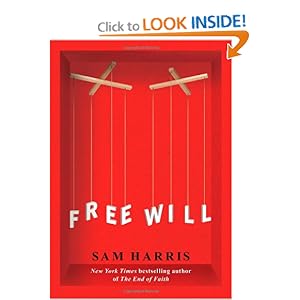
 For the first time that I can remember there are three books recently released that deal with Free-Will, all of which are getting attention from critics, philosophers and even the corner edges of the general public. Why such a topic would be news worthy now is a funny thing. Free-Will is addressed within the first two pages of the Judeo - Christian Bible. Plato, Descartes and Sartre all wrote about it. It is a perennial topic amongst the religious and the philosophically minded. Maybe this is why when I want to talk about it over dinner for the 100th time, my wife rolls her eyes. Or why when I mention that Sam Harris’s book called “Free-Will” is 13,000 words she say's “honey you spout out more words than that on free-will every-night while I am trying to sleep.” Perhaps this is one of those things that should be left alone as unsolvable. The thing is, there has actually been recent scientific research done on the question of free-will, that some claim disproves the possibility, leaving only for a deterministic, or random universe. I am one of those people. I feel that humans may be unique in many things in this vast universe, but being the only matter in nature capable of decision making seems overly myopic, so I discard it simply for that reason (though apparently I take many more words in doing so). So the books by Michael Gazzaniga, and Harris were both good reads and I respect both authors, and of course I am not a neuro-scientist so I learned a lot. Still they didn’t inform me greatly on the issue of Free -Will itself. There is one thought provoking idea that somewhere around word 5000 of the Harris book that occurred to me. The major point that Harris makes in the book is to point out several experiments in which an EEG was taken on a person choosing cards. The results of the study showed that the brain registers a choice of which card to choose, before the conscious person does. This is fascinating, as it does point to consciousness as being an observer of other neural actions. In others words if we are who we think we are, we are just watching, not controlling. It is our vast nervous system that is running the show. To me that doesn’t really address free-will so much as conscious will. Perhaps free-will does emerge in other ways not associated with consciousness, though personally I don’t think so.
 What this all did was make me try to close the gap as far as I could between consciousness and unconsciousness. Picture if we accept two things; that consciousness makes us have the feeling of free-will, and that consciousness is merely observation of our bodies actions. So consciousness is the illusion of control. So is it then possible to be in a state where we are completely conscious, but aware that we have no free-will?
There is one that I have experienced and that is the playing of completely improvisational music. I am not speaking of music which is an improvisation on a song. It is rather an improvisation that just starts and finishes, leaps and drags as it wants for as long as it wants. There comes a time in which the delay from thought to action becomes unnoticeable, and I become aware that the word free jazz is actually wrong, as it is the moment when I know that consciousness is not controlling the music. I am not free. It is just as much my music, as “God Bless America” was Irving Berlin’s, but it didn’t come from deliberation, and I would say it didn’t come from choice. The distance between conscious and unconsciousness had been narrowed to the point where it was fully immersed in the whole self, without the need for decision. (to hear some of this type of playing go here. I am uncomposed and unrehearsed with Frederico Ughi, Daniel Carter, Demian Richardson and David Moss)
While this is my experience, my guess is that others have used other means to allow consciousness to be a pure observer without the need for deliberate action. LSD, or too much Ambien (I have tried this one) for example can do this. This is also why booze frees, or in reality takes away the feeling of choice. Some writers produce inspiring work drunk and others don't. You can feel it in the style. Kerouac wrote without conscious meditation, and was drunk the entire time. Like with jazz which was considered free, I would guess that Jack was not expressing freely what he willed himself to feel, but rather the opposite. He was allowing himself to write free from the illusion of freedom. This is the strange paradox that binds us in a life where rational decision making is required, but for experiential and ultimately scientific reasons we realize that freedom is illusory. While that sounds like bondage, I would look to these arts, and see if when we are really in touch with the moment and have narrowed the conscious band to a sliver of recognition, we are not for those rare moments seeing ourselves as we are. We are blindly, euphorically and honestly determined.


